
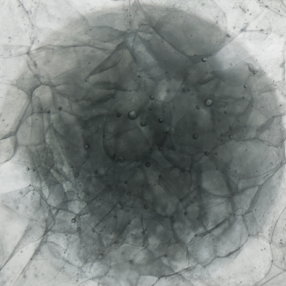
Fraunhofer MEVIS STEAM Imaging Residency Culminates in Interactive Exhibition at Edinburgh Science Festival
How can complex physical processes be made visible and tangible? It was this question that British glass artist Gregory Alliss explored last November during the art residency “STEAM Imaging VI.” The residency, hosted by Fraunhofer Institute for Digital Medicine MEVIS in collaboration with the Institute for Design Informatics at the University of Edinburgh, took place at the research institute in Bremen—providing Alliss with the opportunity to integrate science and art in a truly unique way.
Together with researchers, he developed new formats for communicating magnetic resonance imaging (MRI)—including a STEAM workshop for school students as part of the International Fraunhofer Talent School Bremen. Alliss will present the creative outcome, an installation that translates scientific concepts into glass objects and immersive video forms, at the Edinburgh Science Festival 2026 from April 15 to 26 at Inspace.
“I had an incredible experience,” says Alliss about his two-week stay in Bremen. “Working with the researchers at Fraunhofer MEVIS and freely exchanging knowledge and experience was very inspiring.” Magnetic resonance imaging is one of the established diagnostic procedures—it provides 3D images from inside the body, without radiation exposure for patients. However, the physical concept behind it and the programming of the devices are anything but simple.
“To make the complex issues of Magnetic resonance imaging processing tangible, I took the young people on a journey through glass,” Alliss describes. Specifically, he brought glass elements that could be assembled into so-called MRI phantoms—test specimens to be examined in the scanner. However, preliminary tests revealed a challenge: glass is not particularly easy to scan.
Alliss then developed phantoms in which the signals come not from the glass itself, but by the cavities and structures within it. In the workshop, this change of perspective proved to be a didactic advantage: “The students were able to witness how an initial setback could ultimately lead to a positive result,” says Alliss. “This is a central concept in both research and art.” A special moment in the workshop occurred when one of the young people questioned the concept and thought it through for himself. “Something clicked for him—and suddenly the others also understood how the investigation and development of glass objects in MRI can help to operate the control software for the scanner intuitively.”
In the workshop, participants experienced the actual effects of MR sequences—using MRI simulations with 3D-printed models that made the scanning process visible and audible with
light and sound effects. Further examinations were conducted on compact low-field tabletop devices, and scans of glass objects on a 3-Tesla research scanner, giving students access to use and deploy a range of MRI scanning methods for themselves. The programming tool used was the gammaSTAR software platform developed by MEVIS. It allows MR sequences—the series of control commands for a scanner—to be created easily, without in-depth programming knowledge.
For the MEVIS researchers, observing how the young people used their software was very revealing. “This confirmed our belief that it is possible to provide intuitive access to sequence programming without compromising on technical quality,” emphasizes Matthias Günther, deputy director of Fraunhofer MEVIS and professor of MR physics at the University of Bremen. “This encourages us to think of gammaSTAR as a modular toolbox and to offer different entry levels—from playful and educational in training to clinically relevant and research-oriented in scientific work.”
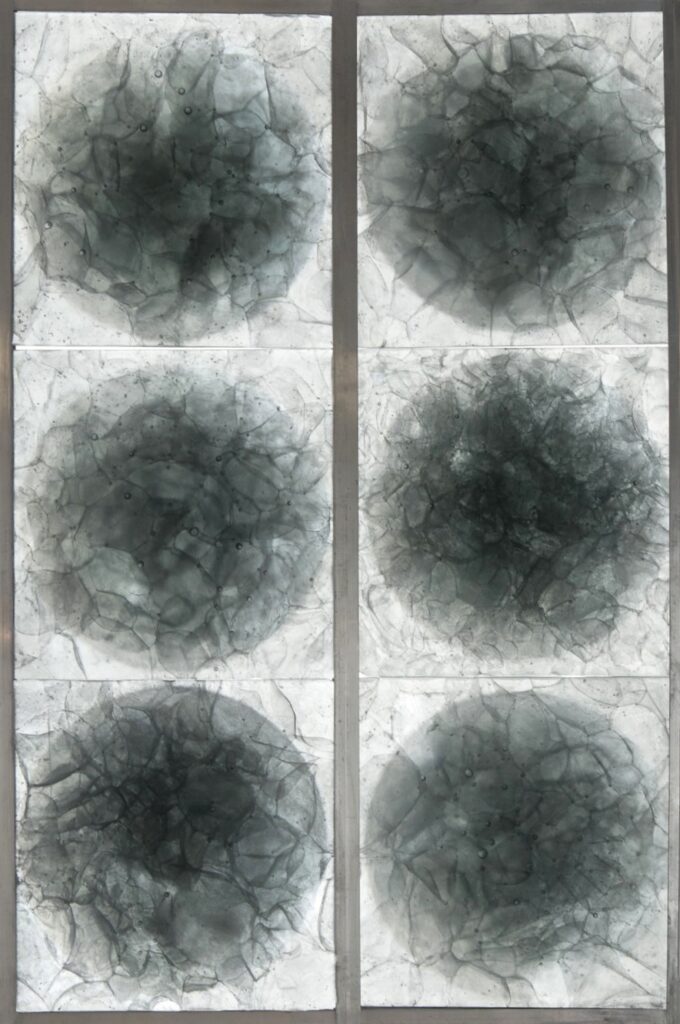
Gregory Alliss incorporates his experiences in Bremen directly into his artistic work. “My installation at the Edinburgh Science Festival is more strongly influenced by my time in Bremen than I initially thought,” he says. The plan is to create a special exhibition that also transcends artistic boundaries and features digital projections alongside central glass works: sculptural forms that make Fourier analysis patterns visible—a mathematical method that decomposes complex signals into their fundamental frequencies. Alongside these, a functional glass “no-field” scanner that allows visitors to experience the simulation of an MR sequence in the form of light and sound pulses, a grid of square glass lenses installed in front of a large window with natural backlighting picks up on the cross-sectional anatomy of medical imaging. This existing work by the artist combined his worlds of art and medical physics for the first time. In the exhibition, it is expanded, with a tablet device enabling visitors to record their own interpretations. Further glass objects made from waterjet-cut or engraved discs merge characteristics of glass and MRI through the replication of veil and interference patterns. Video projections of MRI scans of these objects are combined with the glass works. This creates a direct connection between the physical artwork and scientific imaging.
The entire installation is entitled “Between Glass and Magnetic Fields” and will be set up in a special location: “Our exhibition venue, Inspace, is not a traditional gallery, but rather a living laboratory,” says Miriam Walsh, producer at the Inspace at the Institute for Design Informatics (IDI) at the University of Edinburgh. The premises is equipped with multiple digital projections and large displays—an ideal setting for immersive art. For Walsh, the exhibition aims to open up a space that invites people, regardless of their prior knowledge, to approach the subject of MRI creatively. “We hope that people will ask themselves questions—perhaps even ones they have never thought of before—and thus find their own way of accessing the subject.”
“At its core, the project aims to promote creative innovation and democratizing science,” says Bianka Hofmann, Head of Science Engagement and lead of the Residency Program at Fraunhofer MEVIS. “It opens up new ways to involve more people in assessing and producing expert knowledge—such as MR sequence development—while strengthening trust in scientific work.”
STEAM Imaging VI, hosted by Fraunhofer MEVIS, Germany, in collaboration with the Institute for Design Informatics, University of Edinburgh, United Kingdom, creates a unique opportunity to explore the potential for application of creative multi- and transdisciplinary approaches in digital medicine. The collaboration involves the International Fraunhofer Talent School Bremen and the Oberschule am Waller Ring in Bremen, supported by Ars Electronica, Austria.
Listen to the new audio podcast “Glass Art Meets MRI” with Gregory Alliss, the creator of Between Glass and Magnetic Fields, to find out more about this project: