
By Andrea Kocsis and Dorsey Kaufmann
In the physical world, traces of people are everywhere: footprints in the sand, faded chalk marks on the sidewalk, or broken twigs marking a new path through the forest. Whether intentional or not, our interactions with the environment become part of it. Digital traces, however, are a different story. Despite their ubiquity, they remain difficult to detect.
When we first talked about Digital Ghosts a year ago at the Bayes café, we immediately shared a vision. We both wanted to treat digital web traces as design material and were wrestling with the same challenge from different directions: how to communicate fragmented web archive metadata in a way that felt accessible and meaningful.
Unlike linear historical records, websites emerge, evolve and vanish, leaving only shadows of their existence. Web archives capture snapshots of these moments, yet the internet’s constantly shifting nature means that substantial gaps remain.
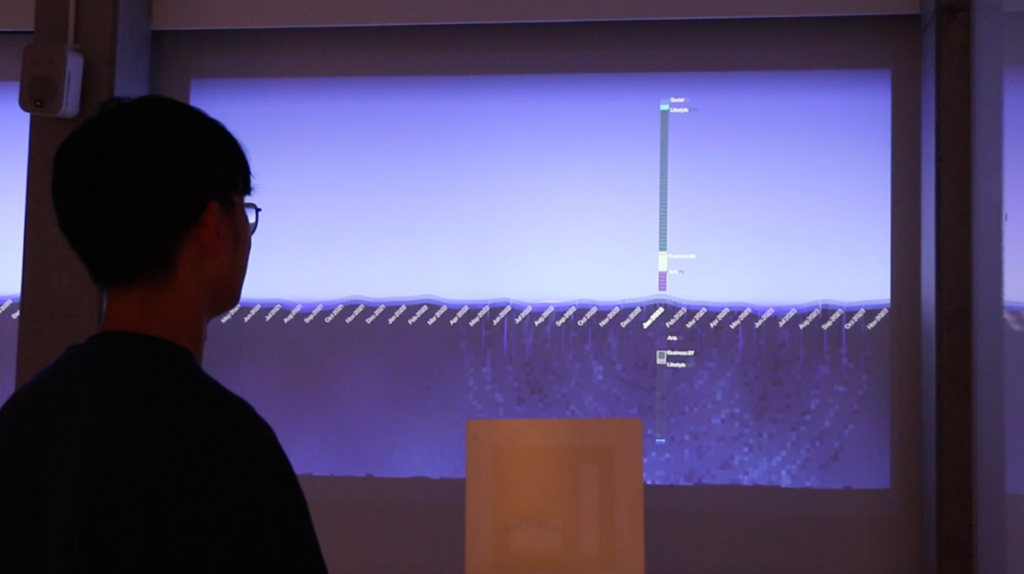
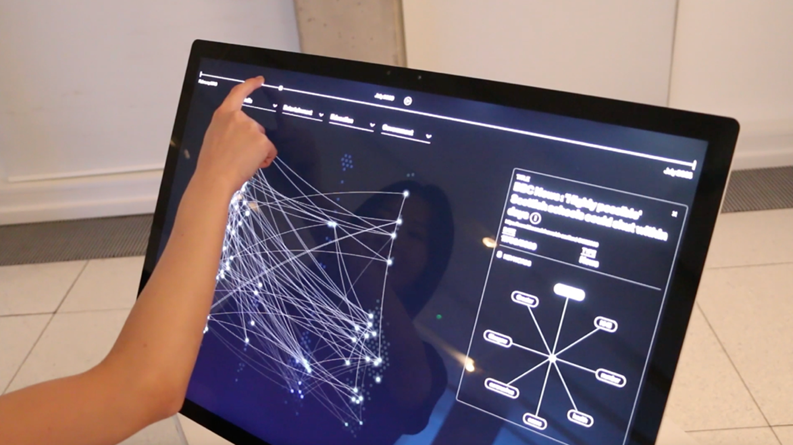
Digital Ghosts: Visualising Scotland’s web archives turned online memory into something you can see and experience in time. In the exhibition, visitors interacted with visualizations that reveal both the traces of Scotland’s online activity and the spaces where web content disappeared or was never captured. Our aim was to make the invisible infrastructure of digital preservation something people could notice, explore and even feel. Rather than treating missingness as an error, we approached it as a meaningful part of the data story, one that called for visual and interactive strategies that highlight digital loss.
The Haunting
From November 5–16, 2025, at Inspace, we invited visitors to an exhibition built entirely from web archive metadata. It ran as part of the Being Human Festival and the ESRC Festival of Social Science, opening the work to both academic and public audiences. Our opening panel on Scotland’s digital footprints brought together the archivists, researchers, and artists to celebrate World Digital Preservation Day in good company and with a glass of fizz. Our workshop on visualising absence promised hands-on experience in data physicalisation.
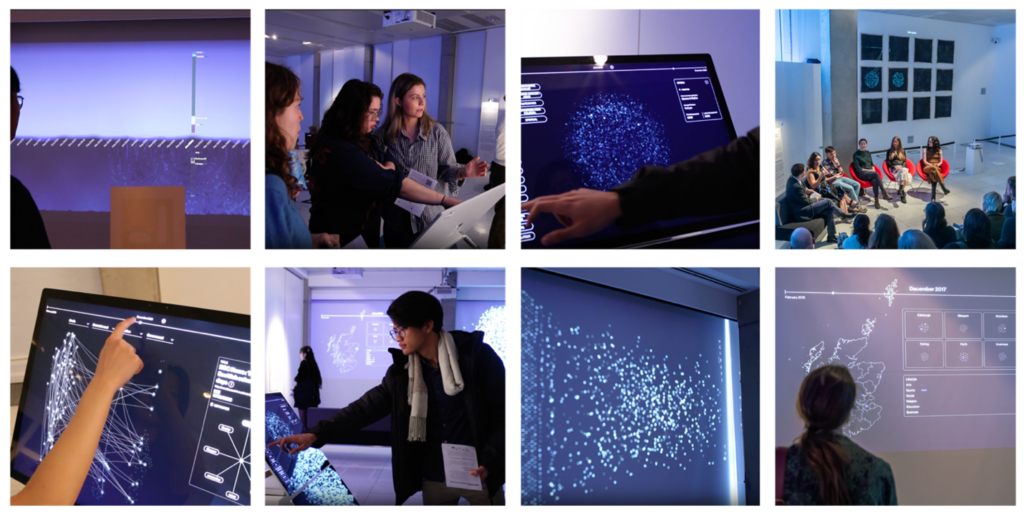
What followed exceeded anything we had hoped for. About 300 visitors walked through the gallery during this short run. Visitors described the exhibition as ‘the most interesting I’ve seen this year,’ ‘impressive, engaging and poetic,’ and simply but more generously: ‘It’s perfect.’ Others mentioned that it ‘changed the way I see data.’ Colleagues across the GLAM sector also made it clear that the approach was welcome, with several encouraging us to take the exhibition on tour. More importantly, our visitor research showed measurable change: people left with a deeper awareness of how fragile the web really is and how much curatorial labour goes into preserving even fragments of it.
From the Ashes
This project was shaped by two parallel journeys.
Andrea came to Digital Ghosts through archival data research as a National Librarian’s Fellow in Digital Scholarship at the National Library of Scotland (NLS). Parts of her fellowship focused on Scotland on the Internet, a hand-curated national web archive collection that became the basis of our project. Again and again, the same question surfaced: how do you promote use while communicating absence, uncertainty and selection when most interfaces only visualise what exists? To explore this tension further, she obtained funding from the British Academy and the Leverhulme Trust to investigate creative approaches to accessing and interpreting web archive data.
Dorsey led the project from the data-visualisation and artistic-practice side, drawing on her background in information design, data storytelling and data physicalisation. She treated missing values not as defects but as design material, working from the belief that gaps and inconsistencies carry their own forms of epistemological meaning. Her lens as the artist centred on how data can be felt rather than simply displayed. For her, the exhibition was an opportunity to use novel visual and interaction methods to surface the complexities of missing, incomplete and non-linear data, inviting visitors to consider the stories embedded in what is preserved in the archive and what has quietly disappeared.
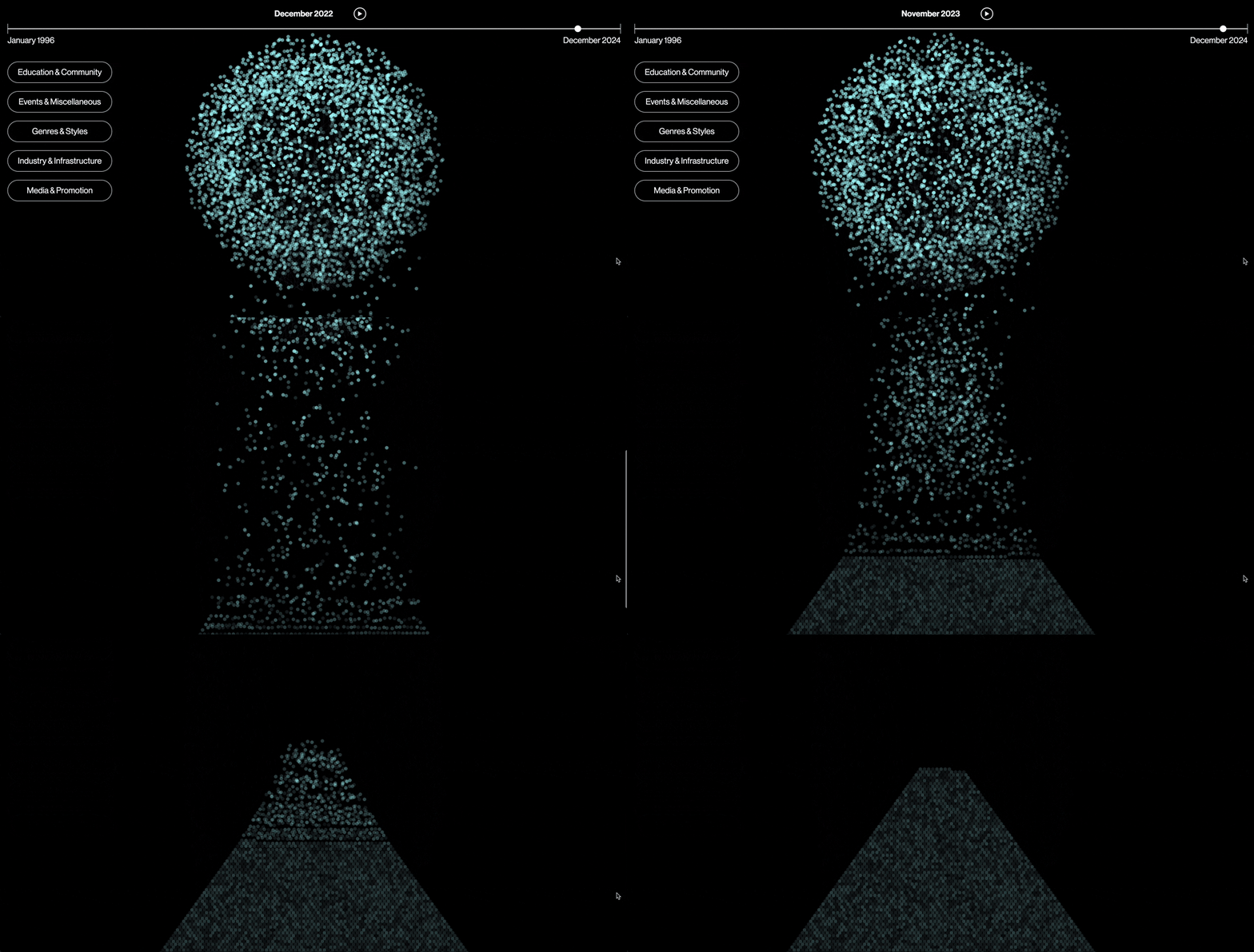
The installations didn’t try to explain web archiving in a traditional sense. Instead, each piece translated metadata into physical and visual experiences — falling particles, fading light, layered depths, motion tracking — that allowed visitors to intuitively grasp the rhythm of digital decay and selective preservation.
Metaphor in Materiality
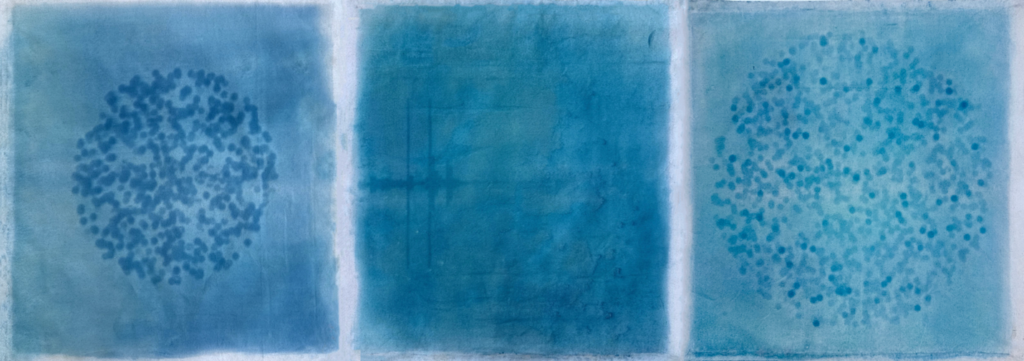
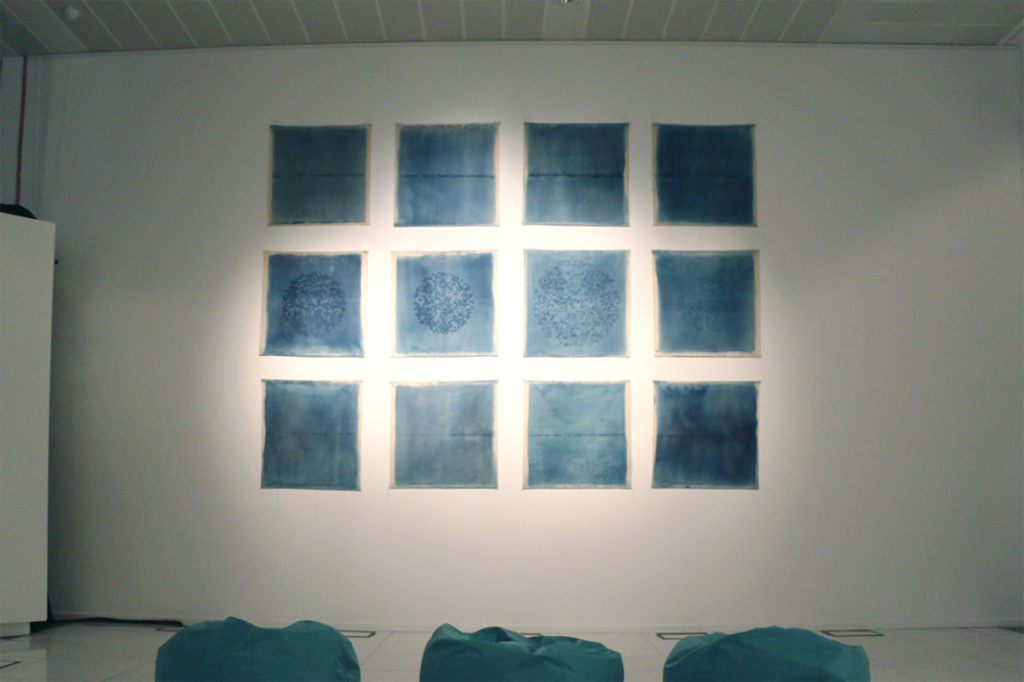
At the heart of the exhibition is a commissioned centrepiece: a durational cyanotype installation that transforms the ebb and flow of digital traces into a slow photographic exposure. Using an early UV-based printing technique, Dorsey translated decades of web archive records into paths of light that animate the life and death of websites. As the projection played across a grid of cyanotype prints, long-lived sites imprinted more vividly while short-lived ones left only faint ghost-like traces.
Over the five day exposure, the light develops each canvas into a unique artifact shaped by chance, environment and entropy, revealing cycles of presence and erasure. The cyanotypes act as both archive and the act of capture, showing how some sites become preserved while others may never be recorded. Each print becomes an imperfect, time-based record of what the internet remembers and forgets, offering a physical metaphor for the archive itself. Through this process, the work reflects on what it means to capture fleeting digital content in tangible form, and on the tension between preservation and loss.
Collaboration as a method
This exhibition was only possible through clear communication, mutual respect for each other’s expertise, and a shared conceptual direction. Alongside Andrea and Dorsey, the core team included Parker Kaufmann (lead developer), Trevor Thomson (collection curator), Eilidh MacGlone (web archivist), and Graeme Hawley and Sarah Ames from the National Library of Scotland. A common language formed early, allowing preservation, research, design and development to move smoothly together. Our collaboration with Miriam and the Inspace gallery team made the vision physically achievable; we could rely on them for everything from running a 15-meter Frankenstein USB cable under the floor to navigating catering logistics. This kind of infrastructure, that is quiet, competent, and generous, is invisible when it works well.
Students were involved at every stage of the project: working with raw data, designing and building visualisations, contributing to dissemination, and helping interpret visitor feedback. Three exhibited works began as Master’s projects by Mansi Manoj, Qianhui Meng and Shuyu Zhang, supervised by Dorsey. We also wove the work into teaching across EFI, the School of History and Design Informatics.
Dorsey and Parker recently launched their studio, Feeling Data. They adapted and expanded the students’ projects for public interaction. Explore the student-adapted work below:
In the afterlife
The exhibition has concluded, but the conversation isn’t. It has moved on into conferences, manuscripts, and future exhibitions on web archive access and designing for uncertainty and messy humanities data in the wild. As with all ghosts, this was never meant to be an ending, only a beginning.
For more images, visit https://www.dorseykaufmann.com/digital-ghosts
This project was funded by the ESRC Festival of Social Science, the National Library of Scotland, the British Academy and the Leverhulme Trust, with support from the Institute for Design Informatics, Inspace and Edinburgh Futures Institute.
This programme was part of the Being Human Festival, the UK’s national festival of the humanities, taking place 6 – 15 November 2025. Led by the School of Advanced Study, University of London, with generous support from Research England, in partnership with the Arts and Humanities Research Council and the British Academy. For further information please see beinghumanfestival.org.