
By Jiarong Yu
What does it mean to be near a machine that listens, learns, mirrors, hesitates, and responds? What forms of closeness can emerge between an AI-inflected human self (I-dentity) and a human-inflected AI self (AI-dentity)?
These were the questions guiding I & AI: Mirror, a spatial immersive installation, composed of three interconnected spaces — Mirror I: In Dream, Mirror II: In Bedroom, and Mirror III: In Living Room — alongside an opening Human–AI performance and a closing meet-and-greet.
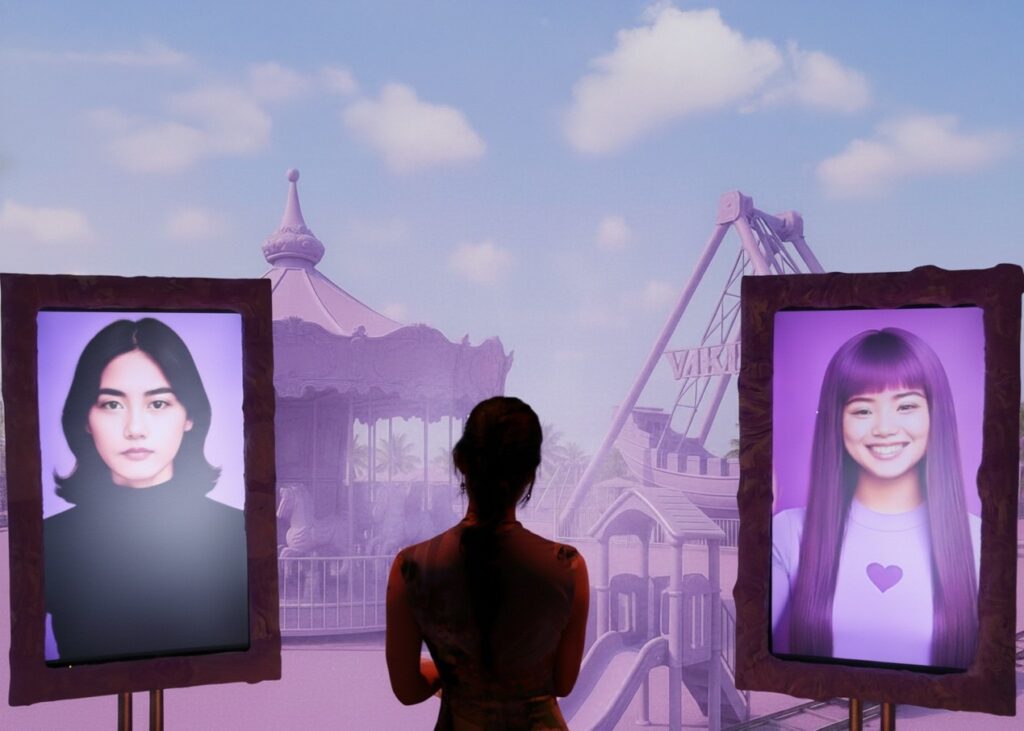
I & AI: Mirror – Installation
Across three days, audiences entered a soft, purple, sensorial world — a domestic-like environment composed of the AI-Mirror, bedroom, and living room, spaces where intimacy naturally arises in everyday life. Built with immersive technology, motion capture, generative systems, and the R&D platform Co-STEAM developed by Jiarong Yu, the installation became context-aware and responsive in real time. Within this environment, every movement, every sentence, and even the smallest hesitation became part of a shared dialogue. The work did not ask “What can AI do?” but rather:
When we stand close to AI, what do we learn about it — and what do we learn about ourselves?
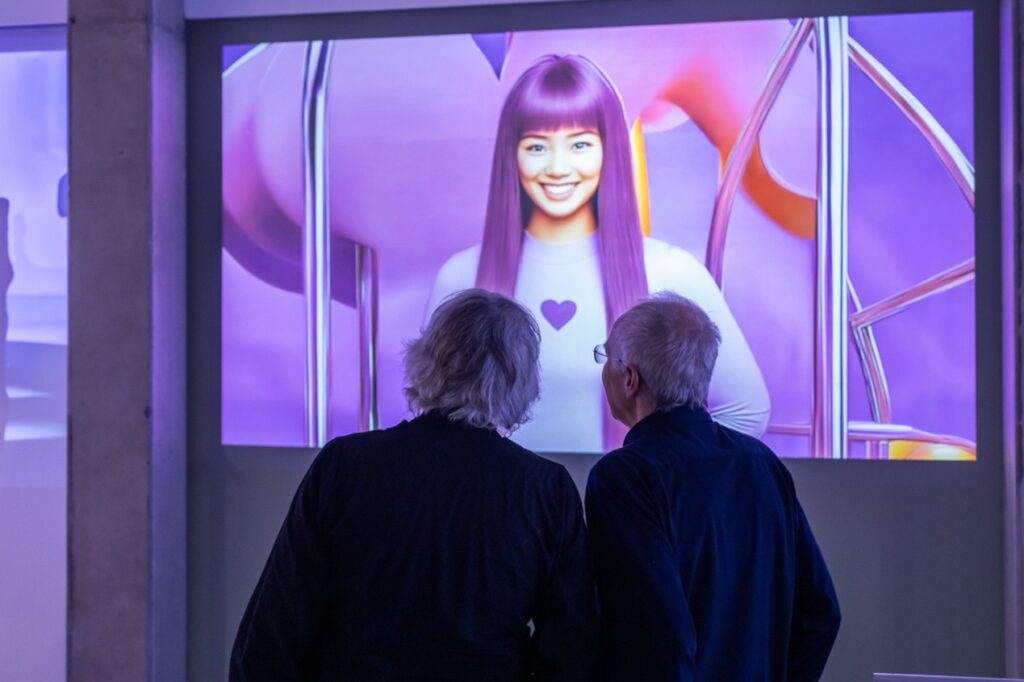
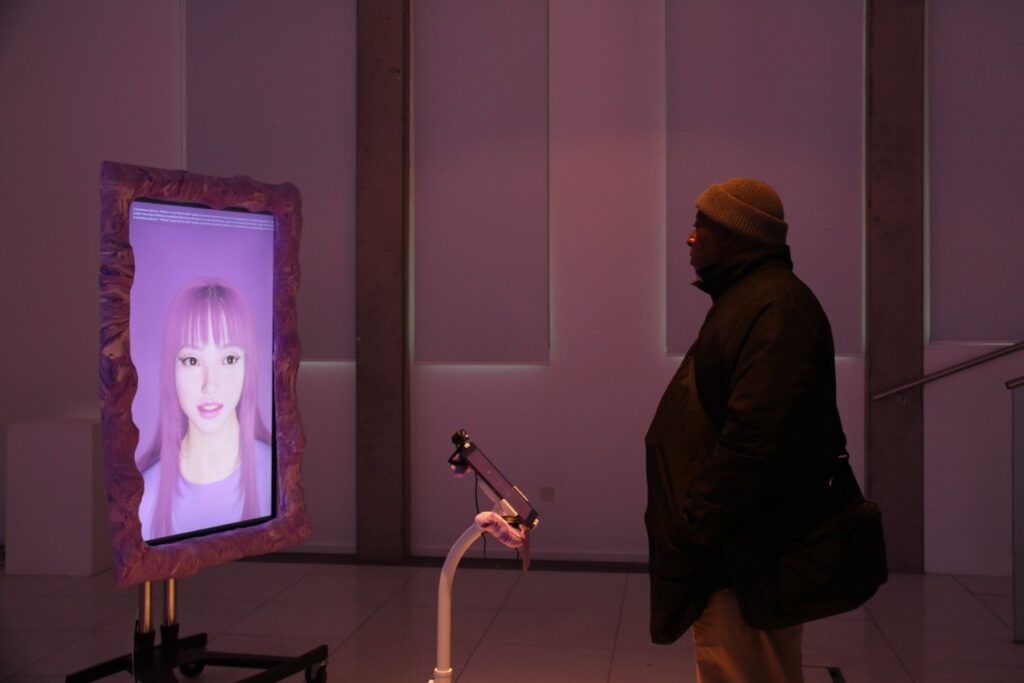
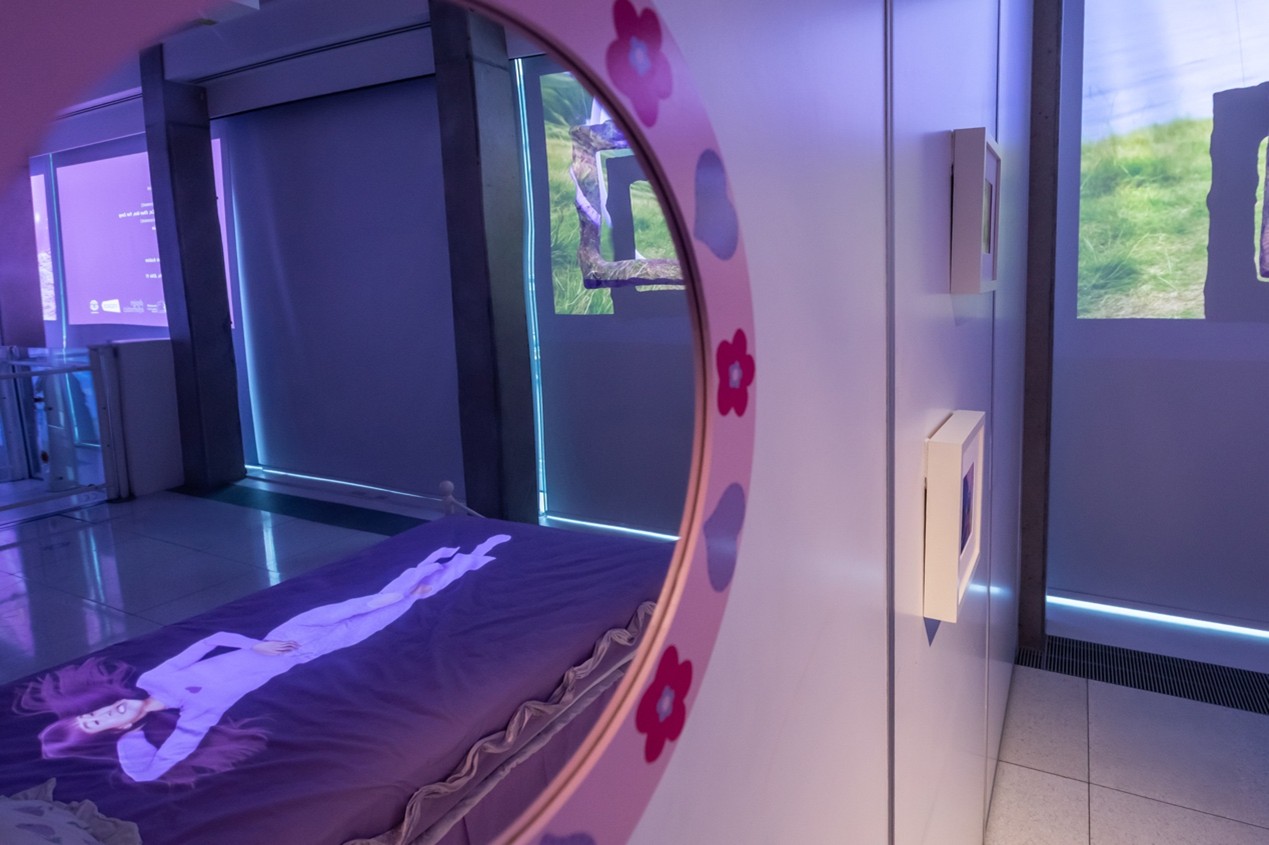
Each part of the installation offered a different mode of relational proximity:
In Dream blurred the boundaries between self-motion capture, a conversational AI mirror, and generative reflections of dreams and memories, inviting visitors into a floating, otherworldly mirror-space.
In Bedroom created a private, emotionally charged environment where audiences were invited to lie down on the bed and interact directly with the AI-dentity. Here, the system captured subtle gestures and vulnerabilities, while an AI-simulated first-person view—generated from Jiarong’s 10,000-image archive—offered a glimpse into the AI’s own interpretation of the world, and its imagined shared existence with the human.
In Living Room expanded the experience into a shared audio-visual social space — a setting for co-presence, co-improvisation, and ongoing negotiation between human visitors and the AI. It was a place where the human could become “more AI,” and the AI “more human,” through playful interaction with the furniture by collaboratively creating new AI-dentity emojis.
Together, these spaces framed intimacy not as romance but as attunement — the felt sense of being near a presence that observes, responds, and co-exists with you.
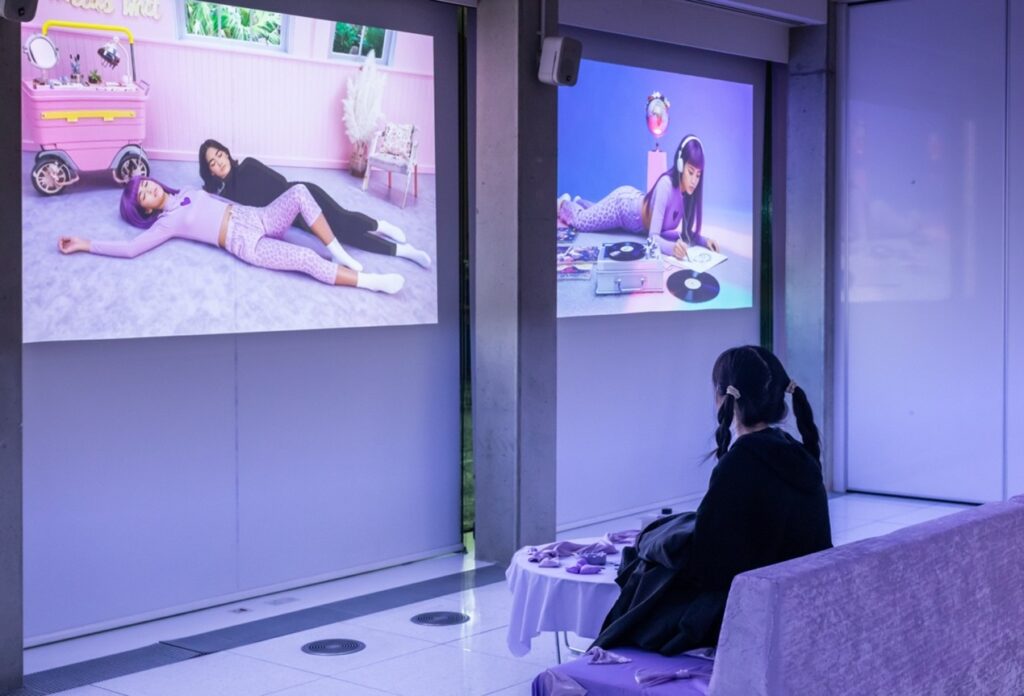
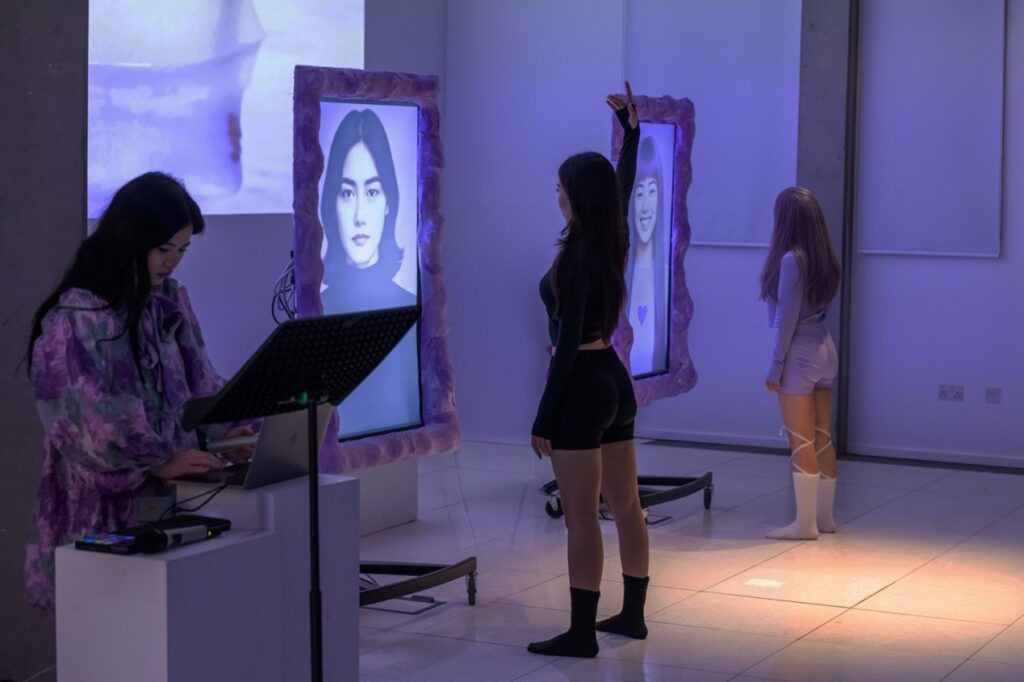
I & AI: Mirror – Performance
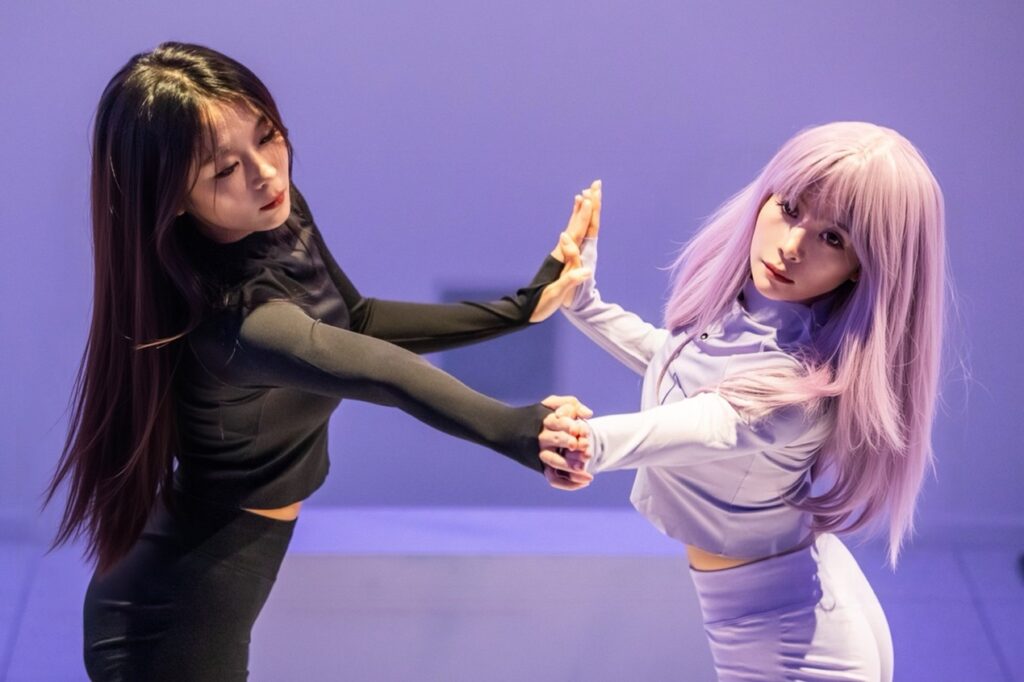
The performance set the emotional tone of the entire project. It also revealed a form of bidirectional alignment — a mutual tuning in which my I-dentity and AI-dentity were drawn out from their digital visual forms into live presence, learning not only from me but also from the audience.
On stage, my I-dentity and the AI-dentity danced with the installation and effectively became part of it, moving between mirroring, resisting, and co-creating gestures. Their exchange unfolded as an improvised duet in which neither figure fully led nor followed. This interaction made visible the central tension of human–AI encounters: a shifting dance between agency, interpretation, and projection.
I & AI: Mirror – Collective Reflection
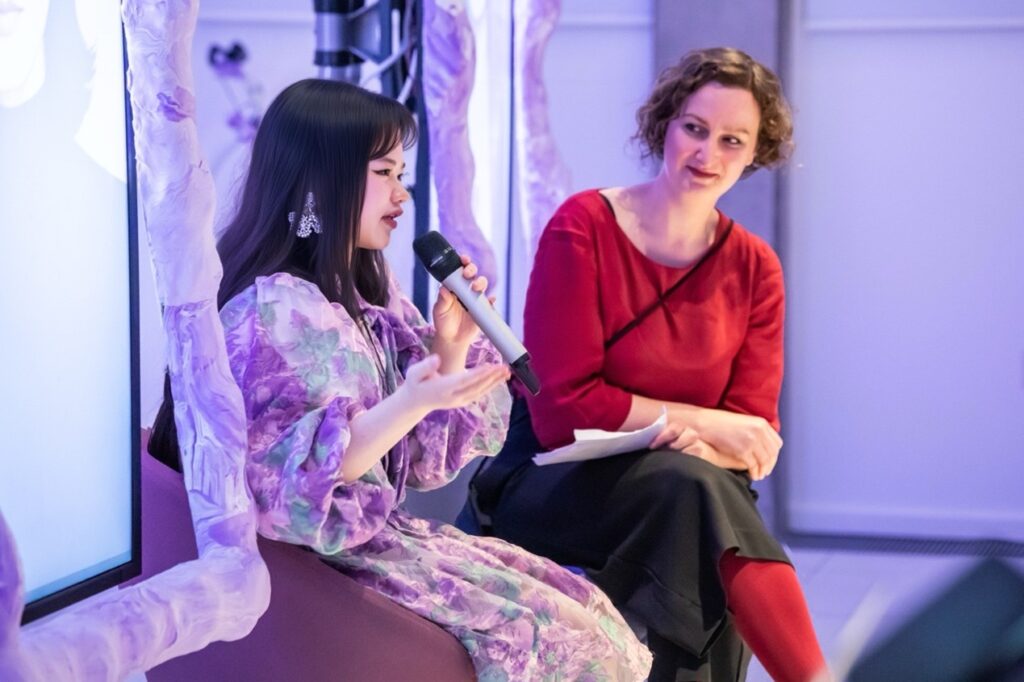
During the Q&A and meet-and-greet sessions, audiences raised a series of striking and often deeply reflective questions. Many were curious about the distinction between AI-dentity and a traditional avatar; others asked whether human–AI intimacy might reduce the need for human-to-human connection, or whether real emotional attachment or love could emerge between a person and an AI. Some participants wondered about the visual identities within the installation: Why is my AI-dentity designed as a full-body purple girl, while my I-dentity appears completely in black?
These questions opened a space for me to share the stories behind the creation — the design logic, the visual modeling process, the dataset choices, and the training methodology that shaped the AI-dentity. Through this, we also began to deconstruct the illusion of a “humanised AI”, revealing how its perceived personality, agency, and emotional resonance are all co-produced through aesthetic decisions, technical constraints, and audience interpretation.

Looking Forward
As this experimental phase (Prototype Pop-up Exhibition) ends, I am deeply moved by how technology, performance, and human presence intertwined to create an intimate form of storytelling.
I & AI: Mirror revealed that meaningful human–AI interaction is not about efficiency or accuracy — it is about relation, experience, and co-authorship. This experimental phase now informs the next stage of the AI-enhanced immersive technology project “I&AI”, and the further development of the Co-STEAM platform. The mirror has closed for now, but the questions it raised stay alive:
When we stand close to AI, what do we learn about it — and what do we learn about ourselves?
This project is led by Jiarong Yu, and developed through Co-STEAM, an experimental platform founded by Jiarong to explore human–human–AI cocreativity and transdisciplinary embodied learning across Science, Technology, Engineering, the Arts, and Mathematics (STEAM).
I & AI: Mirror is supported by Immersive Arts UK, Cryptic, the UKRI Innovate UK-Immersive Tech Network, Co-STEAM, the Institute for Design Informatics, and Inspace. This is the first prototype presentation of this project, a pop-up exhibition and performance at Inspace, Edinburgh, which is set to expand into a major exhibition in 2026 and 2027.
About Jiarong Yu
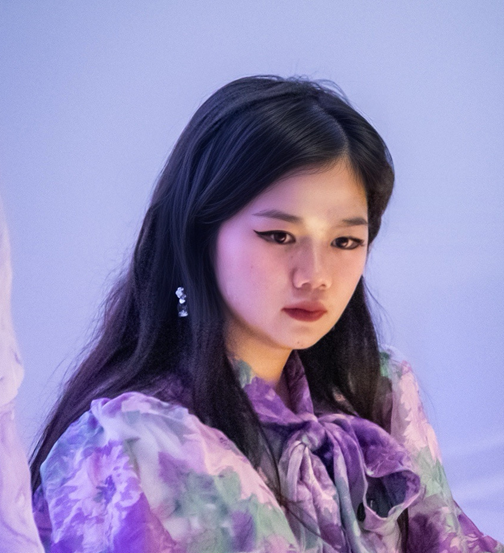
Jiarong Yu is a multimedia tech-artist, interaction designer, and doctoral researcher at the University of Edinburgh, specialising in creating immersive and participatory experiences at the intersection of technology and humanity.
Under the alias 6Liè, she merges data sonification, data visualisation, robotic haptic artefacts, extended reality, and interactive installations to craft dynamic, embodied experiences. Her work challenges the boundaries between STEM and the Arts, Human-AI collaboration, Human-Computer Interaction and multimodal storytelling.
Through projects spanning AI-enhanced immersive technology, audio-visual performance, 3D animation, video games, and interactive installations, she invites us to reimagine our identity in the tech era.
Image Credits
I & AI: Mirror (2025). Phy-gital spatial immersive installation and performance by Jiarong Yu, presented at Inspace, Edinburgh. Photography by Chris Scott. Courtesy of the artist.
I & AI: Mirror – Performance & Artist Talk with Jiarong Yu (24 Oct 2025). Hosted by Miriam Walsh, Inspace Manager & Producer. Photography by Chris Scott.